
English & Chemistry Project Section
Breast Cancer In General and Science
Introduction:
Think Pink is not just a color, it’s a global symbol of awareness for breast cancer. Every October, people around the world wear pink ribbons to support survivors and families.
The purpose of this project for English and Chemistry is to educate students in Bahrain and the GCC about this disease. This essay will cover what breast cancer is, what causes it, how to detect it early, and how a healthy lifestyle can reduce risk. The essay will also debunk common myths and look at specific data from Bahrain and GCC countries for breast cancer. The message is simple: awareness, education, and early action can save lives.
P.S: This essay is for educational purpose and awareness only. People with medical concerns should ask a doctor or go to a local healthcare center.
The Science and Early Detection of Breast Cancer
What is Breast Cancer?

According to the WHO (World Health Organization), Breast cancer is a disease in which abnormal cells in the breast grow out of control and form tumors. If left unchecked, the tumors can spread throughout the body and become fatal.
Breast cancer cells begin inside the milk ducts and/or the milk-producing lobules of the breast. The earliest form (in situ) is not life-threatening and can be detected in early stages. Cancer cells can spread into nearby breast tissue (invasion), creating tumors that cause lumps or thickening. Invasive cancers can spread to nearby lymph nodes or other organs (metastasize). Metastasis can be life-threatening and fatal.
Treatment is based on the person, the type of cancer, and its spread, combining surgery, radiation therapy, and medications.
What Causes Breast Cancer?
The following list outlines potential risk factors that can contribute to breast cancer:
- Gender (Females)
- Age (50+)
- Family History
- Inherited Gene Mutations
- Dense Breast Tissue
- Certain Breast Changes
- Exposure to Radiation
- Etc...
Early Detection of Breast Cancer
There are early signs that may indicate breast cancer, such as:
- A new lump in or near the breast or in the armpit
- An unexplained change in the size or shape of the breast
- Unusual spots anywhere on the breast
- Breast or nipple pain
- Discharge from the nipple, particularly if clear or bloody
- Scaly, red, or swollen skin on the breast, nipple, or areola
- Swollen lymph nodes under the arm or near the collarbone
Prevention and Lifestyle:
There are many ways that we can prevent breast cancer and have a healthy lifestyle. Below, are 4 ways that we can prevent breast cancer from happening, or from increasing from Stage 1.
1. Maintain a Healthy Weight
The link between body weight and breast cancer is complex, but the National Cancer Institute notes that being overweight after menopause increases risk. The ACS also found that rising obesity rates are linked to more cases of HR-positive breast cancer in older women.
2. Limit Red and Processed Meat
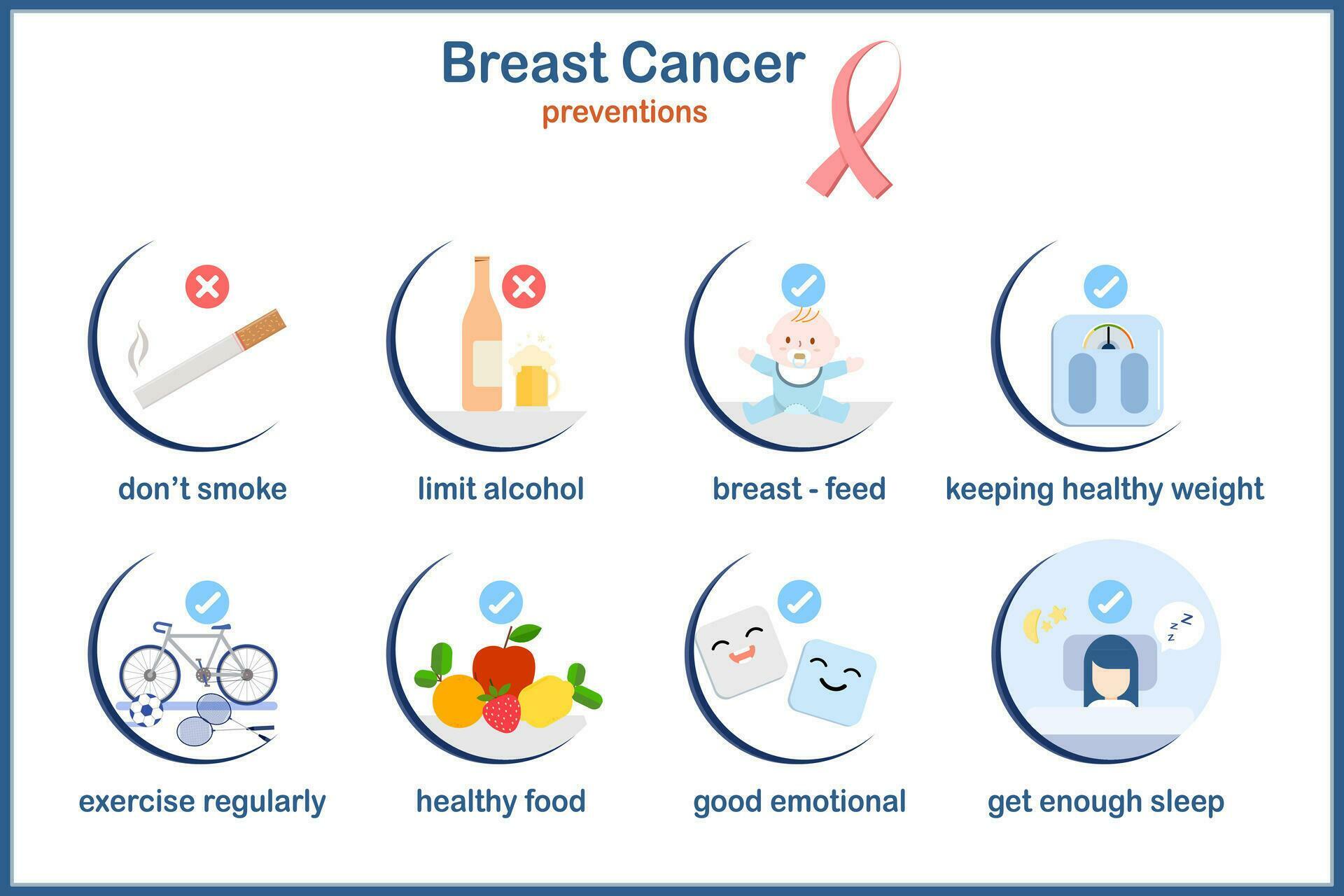
Eating high amounts of red meat (like beef, pork, or lamb) and processed meat (like bacon and hot dogs) is linked to a higher cancer risk. It's important to maintain a balanced diet.
3. Eat More Fruits, Vegetables, and Whole Grains
A diet low in fruits and vegetables is associated with a higher risk of certain types of breast cancer. Nutrient-rich foods help the body stay strong and maintain overall health.
4. Limit Alcohol Consumption
Alcohol is a known carcinogen. Even having just one drink a day can raise risk. In fact, individuals who have 2 to 3 drinks a day have a 20% higher chance of developing breast cancer compared to those who don't drink at all, so limiting or avoiding it is recommended.
Want a quick assessment to see if you are at risk? If so, you can take this short test below. Please note that this test is not a substitute for professional medical advice and is just for informational purposes only.
Breast Cancer Prevention Test
Myths and Facts:
There are a surprising number of myths that people believe are true. 3 will be debunked.
“Most women diagnosed with breast cancer have a family history of the disease or a genetic mutation.”
This is partially false; 10% - 15% of breast cancer cases are caused by mutations in genes like BRCA1, BRCA2, and PALB2. And most women diagnosed with breast cancer do not have a family history of such cases.
“Only older people are diagnosed with breast cancer.”
This is false; most cases do occur with women over 50, but young women can be diagnosed too, and concerningly, rates have been rising by 1% since 2012 for women under 50.
“You can’t take steps to reduce your risk of breast cancer.”
This is completely false. Any cancer risk, especially breast cancer, can be reduced through many ways such as:
- Learning family history.
- Know the “normal” state of the breasts.
- Eat a healthy diet, drink less alcohol, and quit smoking.
- Exercise regularly.
- Ask a doctor to do a breast cancer risk assessment.
Breast Cancer in Bahrain and the Gulf:
Breast Cancer in Bahrain:
Methods: This is a cross-sectional study of women who had screening mammograms in primary healthcare centers in the Kingdom of Bahrain for one year. The study included 2438 women aged 40 years and older.
Results: The most prevalent breast density level was scattered fibroglandular density (Fibroglandular density describes how much of your breast tissue is considered fatty or dense. A breast that has scattered fibroglandular tissue has slightly more fatty tissue than dense tissue.) (55.3%) extremely dense breasts (5.3%) (least common).
The study showed that 68.3% of the reports were normal, while 31.7% of women were recalled for further imaging. The most common reasons for recalls were nodules/lumps in 34.2%.
Additional imaging was done for 69.4% of the cases, while 30.6% of women missed follow-up appointments.
Of the patients needing biopsies, the procedure was performed for 62.5% of the women; of these, there were histologically confirmed malignancies in 31.6%.
Breast Cancer in other GCC Countries:
Breast cancer stands as the prevailing malignancy across all six Gulf Cooperation Council (GCC) nations. In this literature review, we highlighted the incidence and trend of breast cancer in the GCC.
Most of the studies reported a consistent increase in breast cancer incidence over the past decades, which was particularly attributed to the adoption of a Westernized lifestyle in the region and the implications of emerging risk factors and other environmental and societal factors, the increase in screening uptake, as well as the improvement in data collection and reporting in the GCC.
The data on breast cancer risk factors in the GCC were limited. In this geographic region, breast cancer frequently manifests with distinctive characteristics, including:
- An early onset, typically occurring before the age of 50.
- An advanced stage at presentation.
- A high pathological grade.
Additionally, it often exhibits more aggressive features such as:
- Human epidermal growth factor receptor 2 (HER2) positivity.
- The presence of triple-negative (TN) attributes, particularly among younger patients.
Despite the growing body of literature on breast cancer in the GCC, data pertaining to survival rates are, regrettably, meagre. Reports on breast cancer survival rates emanating from the GCC region are largely confined to Saudi Arabia and the United Arab Emirates (UAE).
In the UAE, predictive modeling reveals 2-year and 5-year survival rates of 97% and 89%, respectively, for the same period under scrutiny. These rates, when compared to Western counterparts such as Australia (89.5%) and Canada (88.2%), fall within the expected range.
Conversely, Saudi Arabia reports a notably lower 5-year survival rate, standing at 72%. This disparity in survival rates underscores the need for further research directed toward elucidating risk factors and barriers that hinder early detection and screening.
Additionally, there is a pressing need for expanded data reporting on survival outcomes within the GCC. In sum, a more comprehensive and nuanced understanding of breast cancer dynamics in this region is imperative to inform effective strategies for prevention, early detection, and improved patient outcomes.
Conclusion:
In conclusion, this essay’s research shows that breast cancer is a serious but preventable disease when found early. Risk factors can include gender, age, family history, and lifestyle choices. Many myths are false such as the myth that only older women get affected and that most cases are inherited.
Early signs such as a lump, change in shape, or swollen lymph nodes should never be ignored and a healthy lifestyle, including maintaining a healthy weight, can help reduce risks.
Most importantly, data from Bahrain states the following: out of 2,438 women's screening, 31.7% needed further imaging, which shows why screening is vital. In the GCC, breast cancer has appeared in women before 50, and they were already in an advance stage, so awareness about this issue is essential to be taught in many schools. While survival rates in the UAE are 89%, they are lower in other regions, showing that with awareness and screening, it makes a real difference. Think Pink reminds us to take more knowledge. As students, we can help spread awareness to friends, family, etc. Together, we can break myths, spread the truth, and help everyone suffering with breast cancer.
Sources:
- National Breast Cancer Foundation. (2019). Early Detection. National Breast Cancer Foundation. https://www.nationalbreastcancer.org/early-detection-of-breast-cancer/
- Sile, E. (2026, September 14). 10 Ways to Help Prevent Breast Cancer and Reduce Your Risk. Breast Cancer Research Foundation. https://www.bcrf.org/about-breast-cancer/breast-cancer-prevention-risk-reduction/
- Sile, E. (2025, February 13). Breast Cancer Myths Debunked | Breast Cancer Research Foundation. Breast Cancer Research Foundation. https://www.bcrf.org/about-breast-cancer/breast-cancer-myths-debunked/
- BMS JOURNALS. (2026). Bhmedsoc.Com https://www.bhmedsoc.com/jbms/view-article.php?Article_Unique_Id=JBMS287
- Al-Shamsi, H. O., Abdelwahed, N., Abyad, A., Abu-Gheida, I., Afrit, M., Abu ElFuol, T., Alasas, R., Lababidi, B., Dash, P., Ahmad, M., Dreier, N. W., Ul Haq, U., Joshua, T. L. A., Otsmane, S., Al-Nouri, A., Al-Awadhi, A., Tirmazy, S. H., Alterkait, F., Elsabae, S., … Jaafar, H. (2023). Breast Cancer in the Arabian Gulf Countries. Cancers, 15(22), 5398.https://pubmed.ncbi.nlm.nih.gov/38001658/
- Causes of Breast Cancer. (n.d.). National Breast Cancer Foundation. Retrieved October 6, 2026, from https://www.nationalbreastcancer.org/causes-of-breast-cancer/
- National Breast Cancer Foundation. (2019). Early Detection. National Breast Cancer Foundation. https://www.nationalbreastcancer.org/early-detection-of-breast-cancer/